
A Drop of Wisdom: Choosing Water with Intention

We rarely think about water until we are thirsty.
And yet, water is the quiet medium through which nearly every process in the body takes place. It carries nutrients, flushes waste, lubricates joints, regulates temperature, and conducts the subtle electrical signals that move thought, emotion, and Qi through us. In Classical Chinese Medicine, the Jin Ye — body fluids — are considered foundational to life. When fluids are abundant and pure, the body moves with ease. When fluids are depleted, contaminated, or "empty," the entire system begins to lose its grace.
Summer is approaching, which means we will all be drinking more water. So this feels like the right moment to slow down and ask a question I am often asked in my practice:
What kind of water are you actually drinking, and is it nourishing you?
In this guide, I will walk through the most common types of drinking water available to us in Southern Ontario, from a Western nutritional perspective and from a Classical Chinese Medicine perspective. There is no single "right" answer for everyone, but understanding the differences allows us to choose with intention rather than habit.
Unfiltered Tap Water in Southern Ontario
Unfiltered tap water in Southern Ontario, including the Cambridge, Paris, and Kitchener-Waterloo region, is generally considered safe and well-regulated municipal water. One advantage of our local water is that it is naturally rich in minerals such as calcium and magnesium, creating what is known as "hard water," which may contribute small amounts of beneficial minerals to daily intake.
However, unfiltered tap water may also contain chlorine, trace contaminants, dissolved chemicals, pipe residues, and varying levels of agricultural or environmental runoff, depending on the region and aging infrastructure. While most of these remain within government safety guidelines, many people choose to filter their water to improve taste, reduce chlorine and impurities, and create a cleaner drinking experience.
In short: mineral-rich, generally safe, but worth filtering for taste and gentler impurity reduction.
Brita-Style Filtered Water
Brita-style filters offer a simple and affordable way to improve the taste and quality of tap water. These filters primarily use activated carbon to reduce chlorine, odours, and some common contaminants, often making the water taste cleaner and softer while still retaining much of the naturally occurring minerals like calcium and magnesium.
However, standard Brita-type filters do not remove dissolved solids or purify water as deeply as reverse osmosis systems. They can significantly improve everyday drinking water, but the quality still depends on the original municipal source and regular filter replacement - neglected filters can develop stale taste or bacterial buildup over time.
In short: an easy upgrade from tap, but only as good as your filter maintenance.
Bottled Water
This is the one I want to spend a moment on, because I think it deserves a closer look than it usually gets.
Recent studies have found that many bottled waters contain microplastics and nanoplastics - tiny particles released from plastic bottles, caps, and packaging. One recent study found approximately 240,000 plastic particles per litre of bottled water from store-bought brands. While the long-term health effects are still being studied, researchers have already detected these particles in human blood and organs. Each individual exposure may be small, yet a gentle concern arises when we repeatedly drink bottled water over many years - especially since scientists do not yet fully understand how much may accumulate in the body over time.
From a Chinese Medicine perspective, I sometimes wonder whether these microscopic synthetic particles may also subtly interfere with the body's natural flow of Qi and fluids. The human body relies on delicate systems of communication - electrical, fluidic, energetic, and biochemical. Plastics are non-conductive matter, and they may interfere with the flow of Qi.
Qi naturally takes the shortest, smoothest route to travel, gracefully moving around obstacles. When non-conductive particles are present in our fluids, they act as small obstacles — and the pathways of Qi may no longer flow in a straight, easy line.
In short: convenient, but worth reconsidering for daily long-term use.
Fridge-Filtered Water
Although fridge-filtered water contains more dissolved contaminants than reverse osmosis water, it is generally not a bad choice - as long as the filters are replaced regularly and the inner tubing is kept clean to prevent biofilm growth. Fridge water systems can become stale and biofilm-prone if neglected.
There is one more important consideration: water from the fridge is usually quite cold. As many of my patients have heard me say, Chinese Medicine does not recommend consuming cold food and drinks regularly. Cold drinks can weaken the Spleen and Stomach, which are the centre of digestion and the source of post-natal Qi.
If you drink fridge-filtered water, I suggest pouring it into a glass and letting it come to room temperature before drinking. Your digestion will thank you.
In short: acceptable with proper maintenance, but warm it up before drinking.
Reverse Osmosis (RO) Water
Reverse osmosis filtration works by pushing water through an extremely fine semi-permeable membrane under pressure. The membrane allows water molecules to pass through while blocking heavy metals, chlorine byproducts, bacteria, dissolved salts, fluoride, and many other contaminants. The result is very purified water - often much cleaner than ordinary tap or basic filtered water.
However, because the process also removes many naturally occurring minerals such as calcium and magnesium, RO water can become very "empty" unless minerals are added back afterward through remineralization.
I know this firsthand because my dogs refuse to drink water filtered through reverse osmosis. They don't like the empty taste. Animals often sense these things before we do.
In short: very pure, but stripped of its mineral character and "body."
Distilled Water
Distilled water is produced by boiling water into steam and then condensing the steam back into liquid, leaving behind most minerals, salts, heavy metals, and contaminants. This creates extremely purified water with very low dissolved solids and almost no natural mineral content.
Because of its purity, distilled water is commonly used in laboratories, medical equipment, humidifiers, and appliances where mineral buildup is undesirable. However, for long-term daily drinking, many people find distilled water tastes especially flat or "empty" and prefer to add minerals back into the water to improve taste, hydration quality, and electrolyte balance.
A note on the difference between distilled and RO: Both are highly purified and contain very low amounts of minerals and dissolved solids. Distilling, however, also removes much of the dissolved oxygen and gases naturally found in water, which is why distilled water often tastes especially flat. RO water, being filtered rather than boiled, may retain slightly more dissolved gases and trace minerals depending on the system. Neither contains the natural mineral richness of spring water unless remineralized.
In short: the purest of all, but the most "empty" - best used with remineralization for daily drinking.
RO or Distilled Water Remineralized Through Santevia
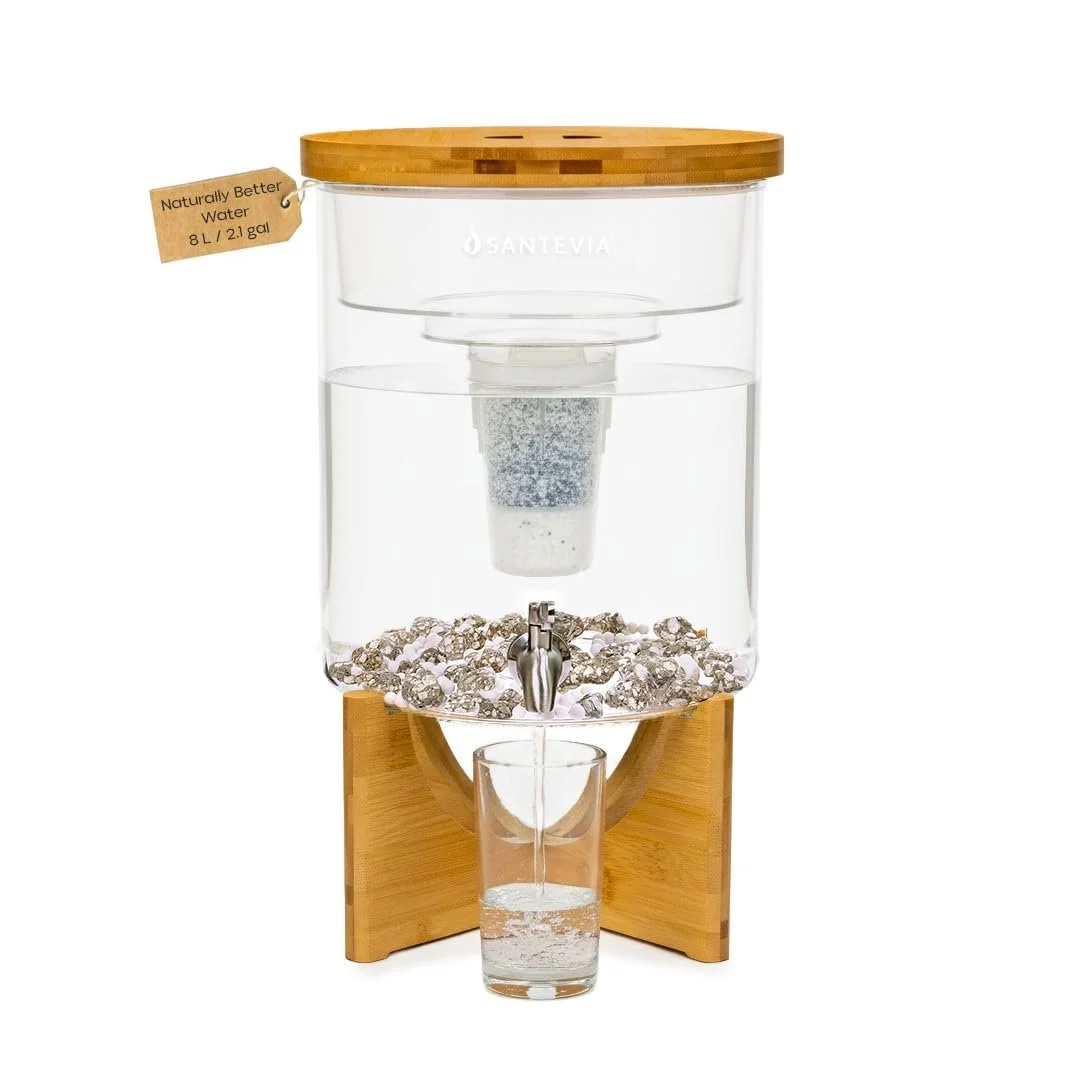
Santevia, Water Filtration System.
This is where things start to feel alive again.
Santevia is a water filtration system designed not only to filter water, but also to restore minerals commonly removed during purification. Its filters help reduce chlorine, odours, and certain contaminants, while a remineralizing stage adds minerals such as calcium, magnesium, and potassium back into the water. This process also gently raises the water's pH, making it slightly more alkaline and often giving it a softer, smoother, more spring-water-like taste.
Rather than producing completely stripped water, Santevia aims to recreate a more balanced, naturally mineralized drinking experience.
A note on pairing Santevia with your water source:
When used directly with Southern Ontario tap water, Santevia filters can produce very mineral-rich water - because our local water is already naturally hard. While this creates a pleasant spring-water-like taste, it may also lead to heavier mineral buildup in kettles and faster biofilm or algae growth once chlorine is removed.
Using distilled or RO water as the starting point for Santevia creates a much cleaner foundation. The Santevia filter can then gently remineralize the purified water in a more balanced and controlled way, often resulting in cleaner-tasting water with less scaling and less biological buildup over time.
On alkalinity: Santevia's alkalizing feature comes naturally from the minerals it adds - particularly calcium, magnesium, and potassium. While the human body tightly regulates its own blood pH, slightly alkaline mineralized water may still offer benefits by providing buffering minerals, supporting hydration, and reducing the harsh "empty" feeling that highly purified water can have. Many people find alkaline mineralized water more satisfying and easier to drink consistently throughout the day.
I bought my Santevia from Amazon.
In short: purified water returned to a more natural, mineralized state - my preferred base.
Adding a Pinch of Mineral-Rich Salt
A tiny pinch of Himalayan or Celtic salt added to Santevia-remineralized water can help restore gentle electrolyte balance and create a more natural spring-water-like profile.
While Santevia already adds calcium, magnesium, and potassium, a small amount of mineral-rich salt contributes sodium, chloride, and additional trace minerals that may improve taste, hydration, and overall mouthfeel.
Himalayan salt offers a cleaner, earthy mineral character.
Celtic salt tends to provide a softer, more oceanic and electrolyte-rich quality.
In very small amounts, both can help transform highly purified water into a more balanced and satisfying daily drink.
Adding 2 Drops of Concentrated Nigari Liquid
This is the final layer in my own daily water ritual.
Nigari is a concentrated mineral-rich liquid traditionally used in Japan to coagulate tofu. It is naturally high in magnesium chloride along with trace sea minerals. When added in very small amounts to Santevia-remineralized water with a tiny pinch of mineral salt, nigari helps broaden the mineral profile and creates a more balanced, spring-water-like drinking experience.
While Santevia primarily restores calcium and potassium, and salt contributes sodium and chloride, nigari gently adds magnesium and subtle ocean-derived trace minerals that may improve the water's softness, hydration quality, and overall mineral diversity. Because nigari is highly concentrated, only a few drops are needed per bottle of water.
A gentler approach to magnesium:
Although 2 drops of concentrated nigari provide a much smaller amount of magnesium than a high-dose supplement pill, the magnesium is already dissolved in ionic form i meaning it may be more easily absorbed and gentler on digestion.
In contrast, magnesium oxide tablets often contain large amounts of magnesium but are known to have relatively poor absorption and may disturb the digestive system, especially in sensitive individuals. From a Chinese Medicine perspective, strong magnesium supplements can feel overly cold and downward-draining to the Stomach and Spleen, potentially contributing to bloating, loose stools, or digestive weakness.
Unless you are dealing with severe constipation, strong muscle cramps, or significant magnesium deficiency, small amounts of nigari liquid may offer a gentler and more balanced way to introduce magnesium and trace sea minerals into the body through your daily drinking water.
In Summary: Water Returned to Itself
Each type of water carries a different story.
Southern Ontario tap water arrives carrying the memory of stone and earth, naturally rich in calcium and magnesium from the region's hard-water landscape. Fridge-filtered water softens chlorine and improves taste while preserving much of these minerals. Bottled water offers convenience and softness, though often at the cost of lower mineral richness and greater exposure to plastic.
Distilled and RO water pursue purity, stripping away not only contaminants but also much of the mineral character that gives water its body and vitality. Santevia gently restores this emptiness by returning calcium, magnesium, potassium, and alkalinity back into the water. A pinch of Himalayan or Celtic salt reconnects electrolyte balance, while a few drops of nigari return subtle ocean-derived magnesium and trace minerals.
In the end, the goal may not simply be purified water, but water returned gently toward its natural state. Water that carries, once again, a quiet conversation between earth, sea, minerals, and life.
A Gentle Invitation
If you would like to discuss how to support your own seasonal hydration, digestion, or fluid balance from a Classical Chinese Medicine perspective, I would be honoured to support you.
Or feel free to text 519-781-6957 or email info@trilliumchinesemedicine.com with any questions or thoughts.
May your spring cleansing feel less like a battle and more like a homecoming.